Cool, I never new we had these roaming around as well, I thought all that was found in our ancient sediments were the more crocodile like critters.
"Scientists have described a new primitive dinosaur species, Eocursor parvus, which lived in the Late Triassic - about 210 million years ago.
Unearthed in South Africa's Free State, the creature appears to have been a small, agile plant-eater."
Showing posts with label factoid. Show all posts
Showing posts with label factoid. Show all posts
Thursday, July 12, 2007


Thursday, June 07, 2007
Now one can see the WWW

This is a view of the Real Time Web Monitor, showing the web traffic. Just one of six views of the Internet and the traffic around the globe. Thanks Akamai!

Great to see corporations letting us mere mortals see what the Net Techies see, it gives one an idea of how the traffic is generated and what amazed me was to see America waking up on the Net, when this was snapped China was asleep, earlier the day the country was a bright white!
Monday, August 14, 2006
An Uri can jump...
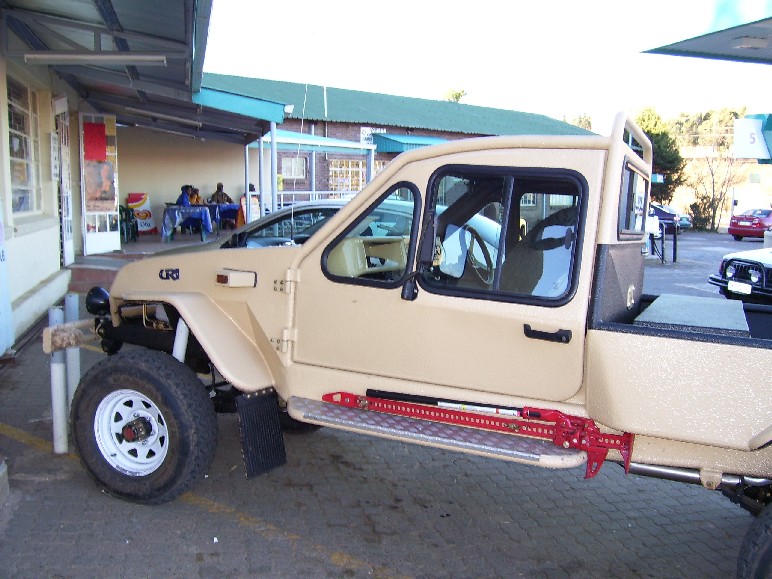 Conceived in the desert of Namibia and built to be as rugged as the country that birthed it, is the Uri utility vehicle, great for any off road mission you plan.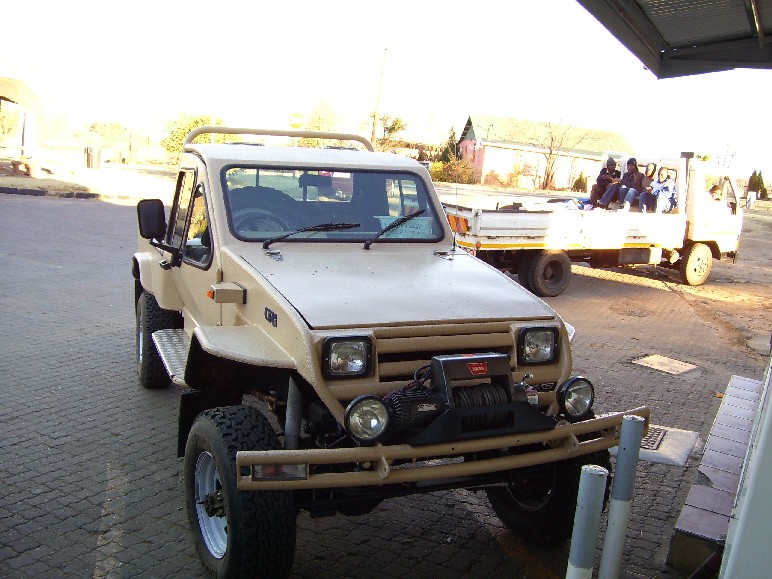
The whole underside and body is sprayed with polyurethane to make it both rustproof and water proof.

Something that is needed when you use it for fishing trips along the Namib with it's salty air.
These great bakkies are now also being built in Pretoria.
The basic versions used to be only 2x4... and can usually go anywhere a 4x4 goes! It is all in the ultralight design and suspension set up. The newer 4x4 versions go where Unimogs fear to tread!
Sunday, July 09, 2006
Alien Invader with a cute name - Fairy Moss
"Azolla filiculoides- Fairy Moss (Salviniaceae)
Small, free-floating aquatic fern with pinnately branched rhizomes. The frond is almost moss-like, 1/16 inch long with 2 lobes, the upper lobe floating, the lower lobe larger and submerged. Sporocarps are produced by the lower lobe. The plant is native from Washington to Mexico and South America"
 View across the dam and mats of Azolla from the Bird Hide on the northen side of the dam.
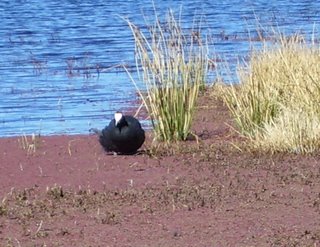 Some of the weed is eaten by waterfowl but not nearly enough!
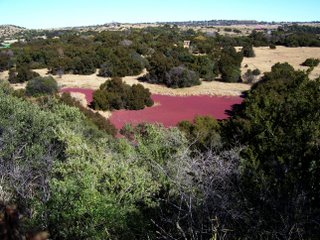 A view from the Koppie down on the lower dam near the N1 highway, which is completely covered!
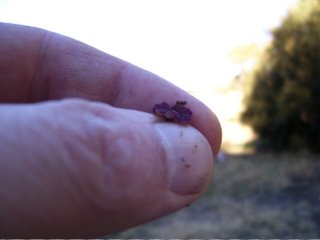 Close up of the critter. Quite pretty and I can see why people would want it in a fishpond or aquarium.
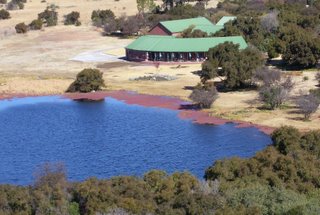 A view of the main dam from the Koppie, not nearly as bad as the lower dam. The Bird hide is in the tree line on the bottom of the picture.
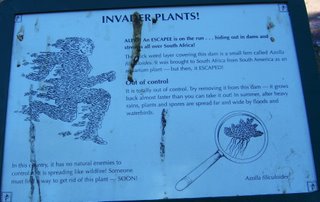 The plaque at the dam wall explaining what the weed is about. Excuse the bird droppings!
"Forms dense mats that choke out other species. Azolla lives in symbiosis with blue-green algae (cyanobacteria), taking advantage of their ability to fix nitrogen. It is sometimes introduced and used by farmers as a natural fertilizer for this reason."
The probable source for our invader in the Botanic Gardens was aquatic gardens and aquariums.
What is interesting is that it can be used as a fertilizer/compost, the problem is finding a economic way to harvest it and at the same time control this pest in our dams and rivers. At least it is not as bad as Kariba Weed! Our cold winters save us from that horrid invader.
Small, free-floating aquatic fern with pinnately branched rhizomes. The frond is almost moss-like, 1/16 inch long with 2 lobes, the upper lobe floating, the lower lobe larger and submerged. Sporocarps are produced by the lower lobe. The plant is native from Washington to Mexico and South America"
 View across the dam and mats of Azolla from the Bird Hide on the northen side of the dam.
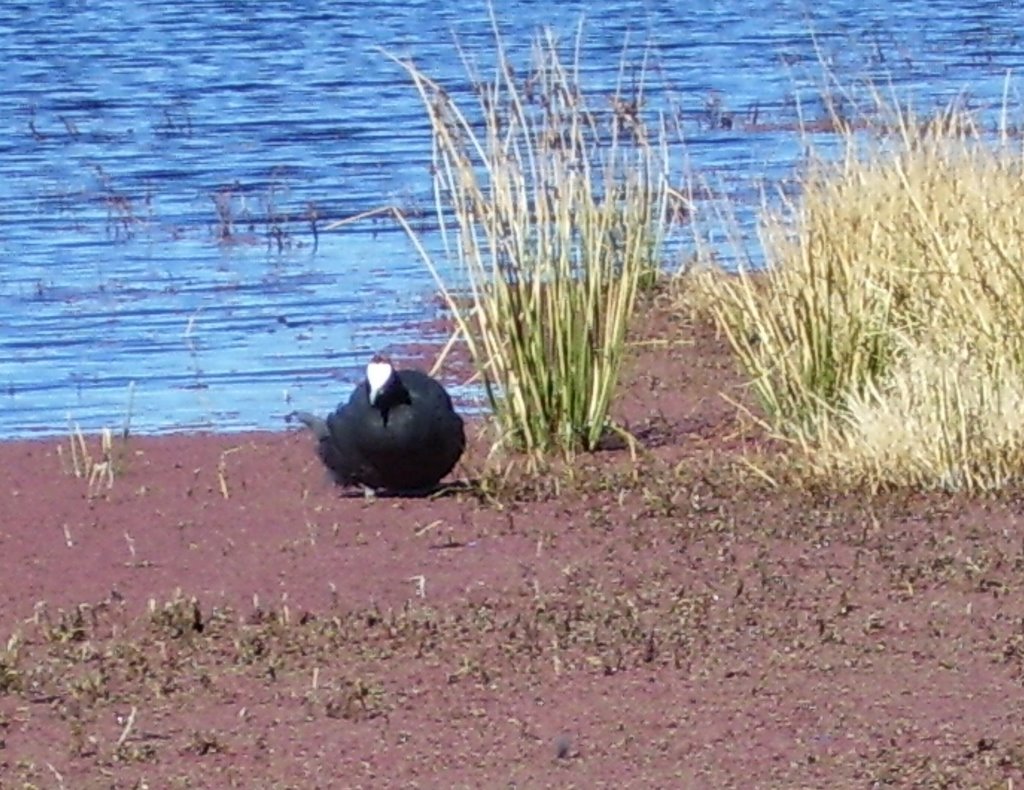 Some of the weed is eaten by waterfowl but not nearly enough!
 A view from the Koppie down on the lower dam near the N1 highway, which is completely covered!
 Close up of the critter. Quite pretty and I can see why people would want it in a fishpond or aquarium.
 A view of the main dam from the Koppie, not nearly as bad as the lower dam. The Bird hide is in the tree line on the bottom of the picture.
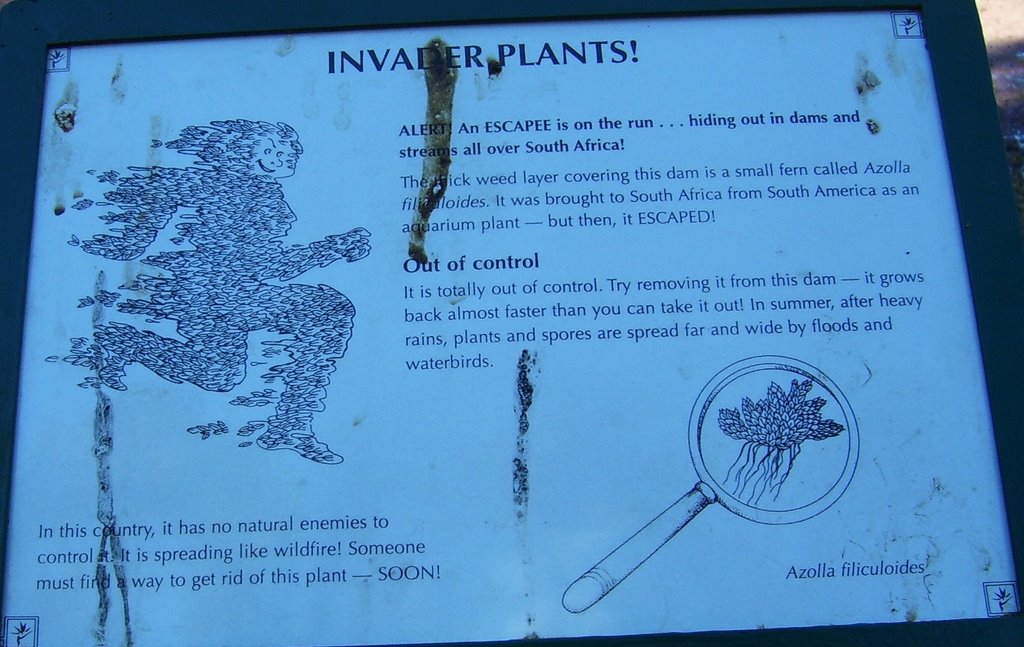 The plaque at the dam wall explaining what the weed is about. Excuse the bird droppings!
 "Forms dense mats that choke out other species. Azolla lives in symbiosis with blue-green algae (cyanobacteria), taking advantage of their ability to fix nitrogen. It is sometimes introduced and used by farmers as a natural fertilizer for this reason."
The probable source for our invader in the Botanic Gardens was aquatic gardens and aquariums.
What is interesting is that it can be used as a fertilizer/compost, the problem is finding a economic way to harvest it and at the same time control this pest in our dams and rivers. At least it is not as bad as Kariba Weed! Our cold winters save us from that horrid invader.
Thursday, June 22, 2006
There is Gold in them thar oilfields
Thomas Gold died this day in 2004 and no one seems to have taken his ideas further.
Further research into Abiogenic petroleum origin may just prove him and others right.
To me it makes sense when time after time hydrocarbons are discovered in space on other bodies in the solar system as well as in space dust. I mean we know more about the surface of the moon than our seas and lithosphere...
Further research into Abiogenic petroleum origin may just prove him and others right.
To me it makes sense when time after time hydrocarbons are discovered in space on other bodies in the solar system as well as in space dust. I mean we know more about the surface of the moon than our seas and lithosphere...
Saturday, June 10, 2006
Diesel... der Vorsprung durch Technik
Lately I have been following the development of using Diesel engines in motorcycles, something that always puzzled me as to why there was a dearth of these creatures.
The problem has been a shortage of technology being applied in this field as well as no company willing to stake their life on the venture.
However I must say this is changing rapidly...
Over on The Kneeslider you can go and see what is being done. One company I want to single out is Neander Motor in Germany... hence the clone of Audi's motto, who are also leaders in the field of auto diesel power in my opinion.
Neander Motor's double crankshaft ohc turbo charges 1.4 Litre bike engine is a work of art as the pictures show, typical Teutonic excellence...

 The motorcycle this brute is going to power is a semi chopper style cruiser. Not my favourite but very impressive to say the least. Another contender is the ThunderStar 1200 from Holland as per this Gizmag article, in Superbike format. The Neander would also do well in the Quad field as it is suited for this type of frame.
What I would like is the Neander single cylinder motor in a CS650 frame,That would be cool! Pity the CS has been dropped, I loved the belt drive... Maybe I should drop BMW and Neander a note...
The problem has been a shortage of technology being applied in this field as well as no company willing to stake their life on the venture.
However I must say this is changing rapidly...
Over on The Kneeslider you can go and see what is being done. One company I want to single out is Neander Motor in Germany... hence the clone of Audi's motto, who are also leaders in the field of auto diesel power in my opinion.
Neander Motor's double crankshaft ohc turbo charges 1.4 Litre bike engine is a work of art as the pictures show, typical Teutonic excellence...
 The motorcycle this brute is going to power is a semi chopper style cruiser. Not my favourite but very impressive to say the least. Another contender is the ThunderStar 1200 from Holland as per this Gizmag article, in Superbike format. The Neander would also do well in the Quad field as it is suited for this type of frame.
What I would like is the Neander single cylinder motor in a CS650 frame,That would be cool! Pity the CS has been dropped, I loved the belt drive... Maybe I should drop BMW and Neander a note...
Tuesday, June 06, 2006
Who needs Red Bull!
 I always smile when I see a Red Bull advert but seems like this personal wing story is actually old news!
The SkyRay was first flown in 2002 already but the proposed use for Special Forces by ESG seems to be a latter idea. I love the header on their site "ESG gives you wings – the parachute system for special operations".
In any case I think this is amazing use of current technology in composite materials.
I wonder if we will ever see a Red Bull air race using these?
Wednesday, March 29, 2006
The Hichhikers Guide to Prime Numbers is 42...
 Who said Sci Fi had no factual basis! I am no Physicist or Mathematician but this is amazing... Douglas Adams probably imagined this but as he was not one of the above either the significance of his "theory" was just a theme of the book, now it seems it could be the theme of the Universe... Truth is stranger than fiction, especially when one delves into the workings of Quarks...
 This quote from Douglas seems to be quite fitting;
I'd take the awe of understanding over the awe of ignorance any day.
Tuesday, March 14, 2006
Comets 'are born of fire and ice'
Comets 'are born of fire and ice' The findings are very interesting and should teach us more on how our corner of the Galaxy originated, however ultimately we and our solar system are the progeny of previous suns... even in the Universe there is evolution. Especially on a elemental scale. As the Universe gets older it gets populated with heavier and heavier elements, maybe this is one way a "Big Crunch" will be initiated?
Thursday, February 23, 2006
Rift vally rumblings
Seems like the East African Rift Valley fault is awakening again, a while ago reports came in from the northern end of new volcanic activity and on Wednesday, February 22, 2006 at 22:19:07 (UTC) a trembler of 7.5 hit Mozambique. All the way in the Southern Atlantic Bouvet island had a rumbling on Thursday, February 23, 2006 at 04:04:05 (UTC), I wonder if the two events were somehow linked? We humans tend to forget that this planet is quite active and is continually flexing it's crust.
Friday, December 09, 2005
Does this matter to Global Warming freaks?
"Many scientists previously thought the reduction in sunlight lowered the Earth's temperature and slowed plant and soil respiration, a process where plants and soil emit CO2. But this new research shows that when faced with diffuse sunlight, plants actually become more efficient, drawing more carbon dioxide out of the air."
Now I was thinking... what if some huge dormant volcano decided it is morning and wakey wakey time, spews the equivalent of 10 Pinatubo's into the atmosphere in a period of a few weeks... what would we do?
Adapt or die I would say, this is exactly what nature does every day this Blue Dot revolves around dear Sol, some organisms die and others adapt. We humans are but a drop in the ocean when compared to what nature itself can inflict on life on this planet... something to bear in mind when the next media Global Warming panic attack starts.
Now I was thinking... what if some huge dormant volcano decided it is morning and wakey wakey time, spews the equivalent of 10 Pinatubo's into the atmosphere in a period of a few weeks... what would we do?
Adapt or die I would say, this is exactly what nature does every day this Blue Dot revolves around dear Sol, some organisms die and others adapt. We humans are but a drop in the ocean when compared to what nature itself can inflict on life on this planet... something to bear in mind when the next media Global Warming panic attack starts.
Monday, December 05, 2005

Saturday, October 08, 2005
Modern potato had roots in Peru
So that means "Pom de Frites/French Fries" should be called Peruvian Fries?
I know that Peru has done extensive research on the spud and has noted where most of the variaties of "wild" spuds are found so as to keep a genetic reserve for the future.
I know that Peru has done extensive research on the spud and has noted where most of the variaties of "wild" spuds are found so as to keep a genetic reserve for the future.
Subscribe to:
Posts (Atom)
