duck... wait for the boom... then take a look outside.
Rule #1 from the Meteor Strike Survival Guide, adapted from the "How to survive a nuclear strike handbook.".
Jokes aside it must have been an awesome and somewhat frightening experience to have been in the Ural mountains Friday last week.
This all happened while MD and I were on our way to a real Boeretroue in Hoopstad. For those that have not attended one and wish to maintain some form of diet... do not accept the invitation!
It was virtually non stop eating from the moment we arrived on the farm until we left on Sunday morning late. Biltong by the bucket load and other delights, then at the reception even more followed by salads and bykosse to die for and enough braai to feed a small army.
Coming back to the meteor... it reminds me of this passage from Matthew 24;
36 “But about that day or hour no one knows, not even the angels in heaven, nor the Son,[f] but only the Father. 37 As it was in the days of Noah, so it will be at the coming of the Son of Man. 38 For in the days before the flood, people were eating and drinking, marrying and giving in marriage, up to the day Noah entered the ark; 39 and they knew nothing about what would happen until the flood came and took them all away. That is how it will be at the coming of the Son of Man. 40 Two men will be in the field; one will be taken and the other left. 41 Two women will be grinding with a hand mill; one will be taken and the other left.
Let us therefore be prepared and live our lives as if each day is the day we will meet Jesus face to face.
Showing posts with label space. Show all posts
Showing posts with label space. Show all posts
Monday, February 18, 2013


Saturday, November 28, 2009
Home is where the love is.
 This is our own Galaxy the Milky Way, our solar systems home in the Universe. Home to an estimated 200 to 400 Billion stars, just in one Galaxy! There are an estimated 100 Billion Galaxies in the observable Universe.
God knows each star by name, (He heals the broken hearted... He counts the number of the stars; He calls them all by name.
Psalms 147: 3-4) , each person by name ("See, I have written your name on the palms of my hands." Isaiah 49:16) and by inference each Galaxy by name. How amazing is that! That we, unobservable specks on an unobservable planet in an average Galaxy circling an average star on a speck of rock are known by name and Loved by the Creator of all.
I give the thanks o Lord for you are King of kings, Lord of all. May I always look upon your works and know your Majesty, may I never stop praising and glorifying your name.
Today I bring you a medley of quotes to ponder...
“The reduction of the universe to a single being, the expansion of a single being even to God, this is love.” Victor Hugo
“The reason why the universe is eternal is that it does not live for itself; it gives life to others as it transforms” Lao Tzu
“Everything is perfect in the universe - even your desire to improve it.” Wayne Dyer
“What makes the universe so hard to comprehend is that there's nothing to compare it with.”
“The creator of the universe works in mysterious ways. But he uses a base ten counting system and likes round numbers.” Scott Adams
The one I like best!
“May my soul bloom in love for all existence.” Rudolph Steiner
Friday, January 19, 2007
McNaught Caught!
 Faintly starting to glow right at the top, in the centre, at last! Comet McNaught caught 19/01/2007... then the camera battery's died! I will be back again tomorrow if the horizon is clear.
Tuesday, July 04, 2006
We have Liftoff... Independence day 2006
 Mission STS-121 is launched on Independence Day... the best fireworks ever for NASA... It may be 3 days later than scheduled but I think one should never overlook coincidences.
 We wish the crew Bon Voyage and a safe return, may this be a sign of more success in the future for NASA and all the people that strive to further the exploration of our Universe.
Sunday, April 23, 2006
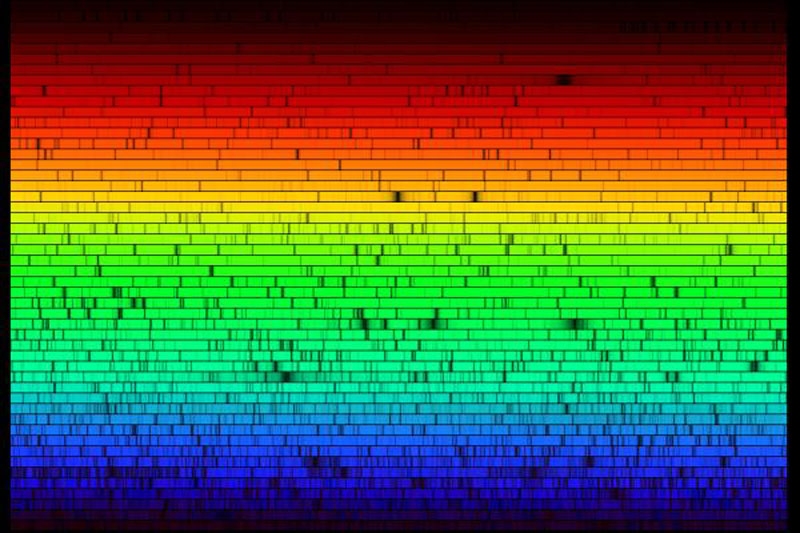
The Solar Spectrum
 APOD: 2006 April 23 - The Solar Spectrum
"Explanation: It is still not known why the Sun's light is missing some colors. Shown above are all the visible colors of the Sun, produced by passing the Sun's light through a prism-like device. The above spectrum was created at the McMath-Pierce Solar Observatory and shows, first off, that although our yellow-appearing Sun emits light of nearly every color, it does indeed appear brightest in yellow-green light. The dark patches in the above spectrum arise from gas at or above the Sun's surface absorbing sunlight emitted below. Since different types of gas absorb different colors of light, it is possible to determine what gasses compose the Sun. Helium, for example, was first discovered in 1870 on a solar spectrum and only later found here on Earth. Today, the majority of spectral absorption lines have been identified - but not all."
An amazing picture with gaps in the knowledge and spectrum which will most probably be filled one day...
Tuesday, March 14, 2006
Comets 'are born of fire and ice'
Comets 'are born of fire and ice' The findings are very interesting and should teach us more on how our corner of the Galaxy originated, however ultimately we and our solar system are the progeny of previous suns... even in the Universe there is evolution. Especially on a elemental scale. As the Universe gets older it gets populated with heavier and heavier elements, maybe this is one way a "Big Crunch" will be initiated?
Wednesday, September 21, 2005
Mars 'more active than suspected'
Mars is having a climate change... Interesting snippet of information... I wonder what is causing it? Must be the 2 rovers running about the place... Oh I forgot... they are solar powered.
Thursday, September 01, 2005
Giant eye spots 'first light'
 Way to go! This is amazing news. The people down in Sutherland have done a fine job, it may be a one horse town with the coldest nights in the country but then that is just what one needs for a starry view. Go and check out what is being done at SALT. This gives an idea of the surrounds of the observatory.
Thursday, August 25, 2005
Barred Spiral Milky Way
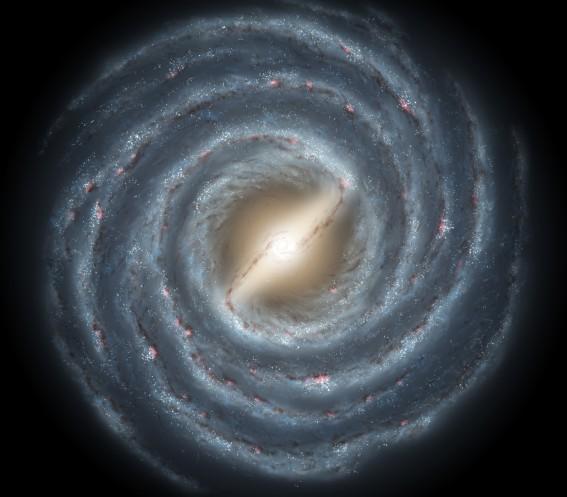 From APOD: 2005 August 25, The Milky Way, if this is what our home Galaxy looks like, we live in an amazingly beautiful Galaxy. This site has some more info and our solar systems approximate location. One can but only speculate as to the extreme conditions at Galactic Centre where a super massive Black Hole probably resides.
This makes me come to the conclusion that spiral systems are a feature of our universe, from atomic level to galactic level and maybe even beyond. Everything spins around something that in turn spins around some more massive thing. Amazing...
Tuesday, July 19, 2005
Latest Supernovae
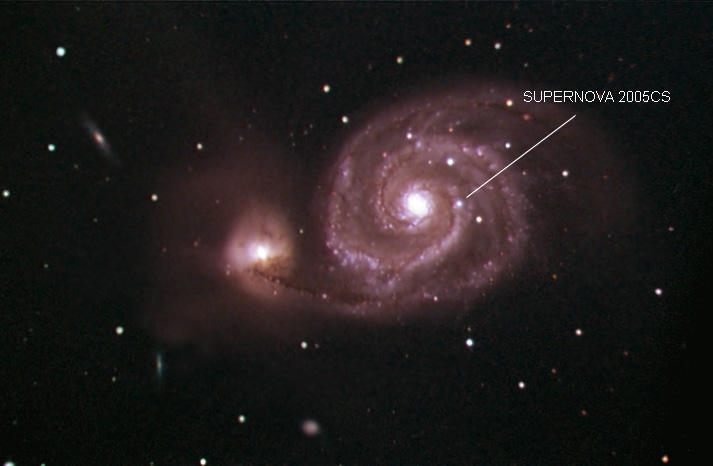 Latest Supernovae This is now a permanent link on my bookmarks/favourites. Some more more images here, I like the one from Michael Howell image best and it is the one posted. So now I will be able to keep track of the latest Supernovae and maybe even get to see one soon.
Saturday, May 28, 2005
Life... Beating the cosmic odds
Is there life out there... yes I believe so... Is there Intelligent life? Not likely... Seems like I am not alone in this view, I think the chances on this is much more slender and that we live on a Privileged Planet... I will detail some reasons why I believe so. Bear with me as this page will be expanded upon from time to time.
The points I will cover will make things clearer. This has also been debated on Space.com.
The Cosmos is inherently hostile to life
Consider the creation of our universe, it was an extremely violent thing and early stars did not have planets at all, planet forming elements just did not exist. If one considers that stars run out of drive so to speak at the Iron stage it was many billions of years before the first protoplanet may have formed.
When one looks at most Galaxies we also see violent environments that to my mind preclude any existence of life. Supernovae and galactic centres beam out massive doses of cosmic radiation that sanitize the surrounding cosmos for thousands of light years.
The green band
Astronomers discover where to find ET
It seems that any life has only a 10% region of possible habitation in most galaxies, the outer regions are poor in elements for life and the central regions are just too hostile for life to exist let alone form.
Two is not company
Recent studies have shown that around more than 50 % of observed stars are Binary Systems and in some cases Quadruple systems. The turmoil in such systems to my logic would just be too much for any lifeforms. We are thus an exception to the rule.
DisaStars
Possible Hyper nova Could Affect Earth
Coming back to Supernovae, there is a class of Nova that spews out such radiation that even being 3000 light years away is no guarantee of safety.
How far is a light year
Then there is the distance factor, even at faster than light speeds it would take years to traverse the galaxy, at sub light speeds it is an insurmountable obstacle to my mind.
Physics or the lack thereof
If there is intelligent life they will have to overcome the laws of physics to travel from one star to another to even make it worth their while.
Do they need us
Any civilization capable of faster than light travel would to my mind find us as interesting as an elephant would an ant.
Do we need them
Here the plight of the Inca springs to mind... when they were conquered by the Conquistadors they had no answer for the technological capability of the Spaniards as well as the biological impact that European illnesses also had on them. What would happen if we were to be invaded by space traveling aliens?
Rare Earth
This is where I come back to my basic argument, when one looks at all the factors that have made this blue dot such a special planet one has to believe that we are rather unique in the Galaxy if not the Universe...
Our Solar system is in a quite backwater of the Milky Way, no big star fields or star forming areas with stars threatening to go nova or other galactic bullies.
Our planet is in the sweet spot... not too close or too far from the single sun, protected by 3 gas Giants from incoming strays.
It has a moon that contributed to setting up geologic conditions for life to evolve.
It has water in the right proportion, not so much to drown the continents and not so little that things have gone into deep freeze like Mars.
In fact the chances are so astronomical that to my mind it is not chance but very much by forethought that we are where we are in the universe. Truly we live on a Rare Earth...
.
The points I will cover will make things clearer. This has also been debated on Space.com.
The Cosmos is inherently hostile to life
Consider the creation of our universe, it was an extremely violent thing and early stars did not have planets at all, planet forming elements just did not exist. If one considers that stars run out of drive so to speak at the Iron stage it was many billions of years before the first protoplanet may have formed.
When one looks at most Galaxies we also see violent environments that to my mind preclude any existence of life. Supernovae and galactic centres beam out massive doses of cosmic radiation that sanitize the surrounding cosmos for thousands of light years.
The green band
Astronomers discover where to find ET
It seems that any life has only a 10% region of possible habitation in most galaxies, the outer regions are poor in elements for life and the central regions are just too hostile for life to exist let alone form.
Two is not company
Recent studies have shown that around more than 50 % of observed stars are Binary Systems and in some cases Quadruple systems. The turmoil in such systems to my logic would just be too much for any lifeforms. We are thus an exception to the rule.
DisaStars
Possible Hyper nova Could Affect Earth
Coming back to Supernovae, there is a class of Nova that spews out such radiation that even being 3000 light years away is no guarantee of safety.
How far is a light year
Then there is the distance factor, even at faster than light speeds it would take years to traverse the galaxy, at sub light speeds it is an insurmountable obstacle to my mind.
Physics or the lack thereof
If there is intelligent life they will have to overcome the laws of physics to travel from one star to another to even make it worth their while.
Do they need us
Any civilization capable of faster than light travel would to my mind find us as interesting as an elephant would an ant.
Do we need them
Here the plight of the Inca springs to mind... when they were conquered by the Conquistadors they had no answer for the technological capability of the Spaniards as well as the biological impact that European illnesses also had on them. What would happen if we were to be invaded by space traveling aliens?
Rare Earth
This is where I come back to my basic argument, when one looks at all the factors that have made this blue dot such a special planet one has to believe that we are rather unique in the Galaxy if not the Universe...
Our Solar system is in a quite backwater of the Milky Way, no big star fields or star forming areas with stars threatening to go nova or other galactic bullies.
Our planet is in the sweet spot... not too close or too far from the single sun, protected by 3 gas Giants from incoming strays.
It has a moon that contributed to setting up geologic conditions for life to evolve.
It has water in the right proportion, not so much to drown the continents and not so little that things have gone into deep freeze like Mars.
In fact the chances are so astronomical that to my mind it is not chance but very much by forethought that we are where we are in the universe. Truly we live on a Rare Earth...
.
Saturday, February 19, 2005
Cosmic blast among brightest recorded - Feb 18, 2005
CNN.com - NASA: Cosmic blast among brightest recorded - Feb 18, 2005
Had this happened within 10 light-years of us, it would have severely damaged our atmosphere and possibly have triggered a mass extinction.
-- Bryan Gaensler of the Harvard-Smithsonian Center for Astrophysics
Had this happened within 10 light-years of us, it would have severely damaged our atmosphere and possibly have triggered a mass extinction.
-- Bryan Gaensler of the Harvard-Smithsonian Center for Astrophysics
Wednesday, November 03, 2004
Long Live Liaka
BBC ON THIS DAY 3 1957: Russians launch dog into space
This was an amazing chapter in the exploration of space but on the other hand so sad that Laika had to perish in the quest for knowledge, I believe we should honour our animal pioneers is some special way. Hopefully this little blog will be just such a tribute.
This was an amazing chapter in the exploration of space but on the other hand so sad that Laika had to perish in the quest for knowledge, I believe we should honour our animal pioneers is some special way. Hopefully this little blog will be just such a tribute.
Subscribe to:
Posts (Atom)

